A: Background Information
Deoxribonucleic acid, most commonly known as DNA, is a molecule which is present in all living things and all cell types. It contains all genetic information and carries information which allow all cells to function, in addition to all physical characteristics which makes everyone unique. A humans DNA sequence is 99.9% alike everyone else. It is 0.1% which makes everyone unique from one another. All DNA instruction is a combination of half of each parent. All cells in the body contain these set of instructions.
DNA has a double helix structure, two long strands of molecules intertwined and aligned with each other to form chemical units called bases. These bases are named adenine, guanine, thymine, and cytosine, however are abbreviated by the letters A, G, T and C. Each of the bases are connected to a sugar and a phosphate, which create a nucleotide (one unit consisting of a sugar, base and phosphate). The two strand DNA contains pair up through bases, so A always pairs with T and G always pairs with C.
DNA is in the nucleus of every cell in the human body, except red blood cells. The DNA is organized into chromosomes, thin long strands of tightly wrapped DNA around proteins. The human body contains 46 chromosomes (23 pairs), which contain all the information in the genome, the full DNA sequence of an organism. There are about 40,000 genes in the human genome. A gene is a part of DNA that contains information to make a protein, which are the basis for all the body's function and structure. The mater code for protein synthesis is ribonucleic acid, RNA, molecules called messenger RNA, mRNA. all mRNA molecules are a copy of the DNA sequence from a gene. They carry information from the DNA to the ribosomes, which are in the cytoplasm and manufacture proteins. The ribosomes decode the gene's information and find the amino acid to link it with so the protein can be made. All proteins are created this way to give the cell its characteristics.
B: Objective and Purpose
The objective and purpose of this lab is to extract the DNA from cells and be able to look at it. You will use your cheek cells and extract the DNA to make it into a DNA necklace! Although, scientists don't use this procedure to create DNA necklaces. By understanding the way our DNA works, scientists will be able to find cures for diseases, genetic disorders and many different kind of syndromes or possibly even finding the key to a longer lifespan. These new discoveries will help everyone learn more about the mysterious information encoded in our DNA.
C: Procedures
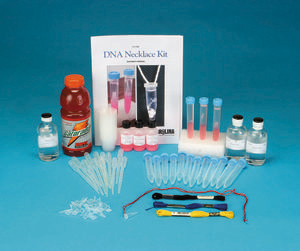
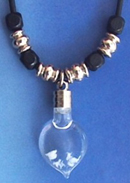

My DNA Necklace!
Discussion
A: Analyze and Explain Data
Throughout my lab, I never saw any change in my DNA solution until I poured the cold alcohol into it and let it sit. After about three minutes I began to see the separation of my DNA. However, I believe that was how the results were suppose to be because the DNA should not be able to be seen until that step. Although, finally when I saw my DNA strand, I used my plastic pipette to grab it and put it into my necklace, which was a little hard. However, the lab went very well and I am very happy with my DNA necklace!
B: Possible Sources of Error
There are a few possible source of error in the lab that could affect your results. A few are; if you did not chew on your cheeks enough, if you did not invert the solution the way the instructions asked you to, and/or if you did not wait the time that the instructions asked you to when you were removing the tube from the hot water or waiting for the alcohol to precipitate the DNA. If you did not chew on the your cheeks enough, you may not have enough cells to create the DNA chain. If you did not invert the solution correctly, for example the lysis buffer, your membrane may not have broken up correctly and your DNA chain may never be made. Finally, if you did not wait the amount of time the instructions asked you to for the alcohol to precipitate the DNA, you maybe not be able to fine the DNA when you are trying to remove it and put it into your necklace.

Most excellent - A+
ReplyDelete